Sunday, September 30, 2012

Stuffed Pork Roast in Honor of Fermentation

The Space Between Fresh and Rotten – A Fermentation Festival

Reedsburg Fermentation Fest Photo

According to Katz, fermentation is the flavorful “space between fresh and rotten, where the world’s most prized delicacies exist.” – Milwaukee Journal-Sentinel, September 9, 2012.

Sandor Katz is a man of sublime truth. He’ll be a participant at the Live Culture Convergence, this year’s edition Fermentation Fest – that will run from October 12th through the 21st  in the general vicinity of Reedsburg Wisconsin [Link]. He wrote the bestselling book Wild Fermentation. Riveting.
Many might dismiss a fermentation festival as odd, but then sometimes the most beautiful lunch can simply consist of a little bread, some wine and a few slices of cheese. Top it off with a few pieces of chocolate for desert. That beautiful lunch was all a product of fermentation. In that light a fermentation festival isn’t odd. It makes perfectly good sense.
And almost larger than life, compost falls into the category of things fermented. We don’t think of it that way, but it is. More importantly, it is the mother that nurtures fertility.  
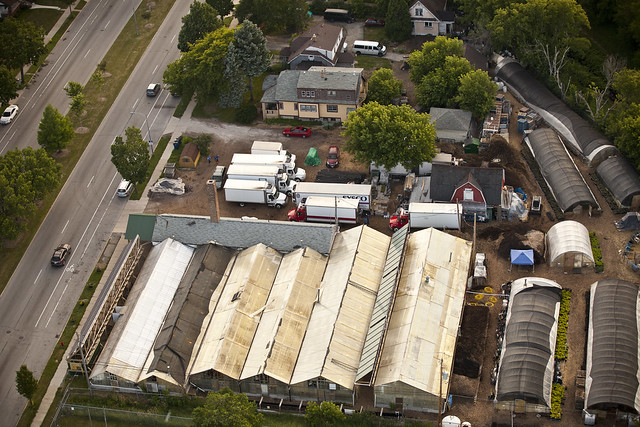
Growing Power Photo  -- An Urban Farm
Milwaukee’s Will Allen is all over that story. It seems, he’s writing an interactive textbook, scattered among small postage stamp sized plots of land, here there and elsewhere. The book’s title is Growing Power [link], but it isn’t a book. It’s a model.
The Fallacy of “Organic”
“Organic” has been has been the high profit, boutique side of agriculture for a long time. It’s been thought by many to be the salvation of the diversified family farm. For some it has been. The Organic Valley Co-Op in southwestern Wisconsin [Link], for example, has been hugely successful. But it isn’t necessarily a panacea.
Compost is part of the organic farming method but it doesn’t favor small farmers alone. Corporate/industrial farms can spread manure to grow organic produce and animal feed. And they do. A confined animal feeding operation (CAFO) can produce “organic, cage free” chickens, reap all of the benefits from that label and do so with little additional costs. “Organic” doesn’t necessarily imply all that we might think it does. It doesn’t necessarily imply wholesome foods produced through agricultural and environmental best management practices.
The trouble is the economics of food production is always weighed in terms of the cost of production versus the market value of crop. So land spread raw manure is an organic alternative to commercially produced nitrogen fertilizers. Well manure isn’t soil. Nutrient overloaded waterways don’t distinguish between organic and commercial fertilizers. What’s lost in the equation is the value and beauty of fermentation.
Will Allen's Composting Urban Farm
That’s where Allen’s model is a game changer. The finished crop isn’t the only product brought to market. It’s one of many byproducts of fermentation. 
On Allen’s farm soil is the first product. Everything else is a byproduct from producing soil. On Allen’s urban farm, organic feedstock for composting is the first stream of revenue. He is first dollar comes from picking up and disposing of vegetable wastes from restaurants, grocers, and produce wholesalers. On that he competes with the land fill garbage haulers.
That garbage is his raw material. From it comes a second stream of income in the form of the organic potting soils and slow release organic fertilizers he sells.
Earthworms and worm castings are a cash byproduct from the compost heap. Finally year round fresh salad greens, herbs, mushrooms and tomatoes are a final compost byproduct.
Years ago when I first visited his Milwaukee three acre farm, he estimated that as a family business it could produce nearly $500,000 net revenue a year. Allen stumbled into a new way of viewing agriculture. Rather than looking at economic model based on cost inputs and harvest yields. Allen instead saw the entire process from compost to table ready produce as productive. The result is an economically viable, environmentally sound, highly intense agricultural method suitable for small acre farms. It makes small footprint urban agriculture commercially possible.
The cost input isn’t fertilizer, herbicides, insecticides and hybrid seeds. It’s garbage, which he get paid to haul away. His farm-to-market logistics do not require a legion of food processors, transporters and wholesalers to resolve.
Allen is the son of a sharecropper whose career as a professional basketball player in Europe led him to rediscover his love for the garden and growing things. One thing leads to another. Allen’s basketball career led to a corporate career. His marriage and love of growing things lead to taking over his wife’s parent’s vegetable farm. The farm led to his purchase of the site of few vacant greenhouses on Milwaukee’s urban north side. He thought of it as a produce market for the farm. One thing leads to another. His willingness to help out a local boys and girls club establish a garden on his property, as a club activity, led to putting the three acres back into agricultural production.
Ultimately, the greenhouses led to Growing Power [Link], an internationally renowned non-profit educational organization demonstrating the viability of small site urban agriculture and the distribution of locally produced foods. It’s hands on. A conference it hosted a few weekends ago drew more than 2000 attendees from around the world.       
The Mystery of Bread -- Fermentation Forgotten and Remembered
It seems the mysteries of fermentation are seeing renewed attention in our increasingly manufactured and digitized environment. With that, we would do well to pay attention to bread. It is our culinary corner stone. And before we turned the baking of it over to the large commercial bakers, a fine loaf was presented as part of almost every meal. It offered a beautifully chewy explosion of yeasty flavor that filled both body and soul. It’s something not to be wasted.
What had once been the crown jewel of our diets has become an uninspired and insipid ingredient for sandwiches and toast. The large scale commercial bakers, like the large brewers, are interested primarily in an acceptable, uniform product with a long shelf life. With that, the individual and often unpredictable glory of fermentation is carefully removed from the recipe, and so are its delights.
The home brewer or baker has no fear of fermentation’s unpredictable charms. Things sometime go badly, but more often wonderfully well.
Turning back to the simple supper of a good soup, good bread, a few slices of cheese and a decent glass of wine or beer, in it are all the elements of a charming and delicious meal. Replicate that with a condensed soup, a soggy, enriched, machine sliced commercial white bread, processed cheese and a “light” low calorie beer, and the result might be as nutritious but it will be miserable.

Adding Fermented Goodness to a Pork Roast
Unrolling the Roast
Our bread has been so degraded that we settle for grossly inferior bread crumbs, and rarely think of bread dressing. If we do think of the bread dressing, it comes in a boxed kit with almost flavorless croutons.
So good stuffing begins with the bread. It should be bakery bread or rolls. If you’re frugal, it will come from left over bread and rolls that have become somewhat stale. These are cut into croutons and thoroughly dried in a 200o oven for about an hour. Stored in an air-tight container these keep almost forever and are ready to use for bread stuffing or ground into bread crumbs.
The Roast Secured for the Oven
The bread dressing here is a simple sage dressing. It could be many others. For pork a bread dressing with apples and spinach is beautiful. I’ve made it in the past, but have not written a recipe for it. So unless you’re adventurous a sage dressing will do.
Stuffed Pork Roast for Six
1 ¼-1 ½ pound pork sirloin roast flattened
6 cups of sage dressing
Out of the Oven
4 strips of bacon
Sage Dressing (about six cups)
¾ Cups diced celery
¾ Cups diced onion
3 Tablespoons butter
1 Heaping Tablespoon sage
2 Cups chicken broth (must be low sodium)*
2 Cups beef broth (must be low sodium)*
4 -6 Cups bread croutons
*Bacon figures into the final roast. There is plenty of salt in that.

Saute the onions and celery in butter. When the onions are translucent add the broth and sage. Bring to a boil then simmer for ½ hour. Gradually add croutons to make a stiff dressing. If necessary ripped up fresh bread can be added to stiffen.
1 ¼ -1 ½ Pound Pork Sirloin Roast, Flattened
To flatten the roast, think of it not as a round log but a spiral. To unroll the spiral begin cutting horizontally along the bottom of the roast at a depth of about ½ inch. Unroll the roast as you cut. This will yield a large pork cutlet. Place this between two sheets of wax paper and additionally flatten it with a mallet to somewhat uniform 3/8 inch thickness.

Sliced and Ready for Gravey
 Stuffing the Roast
Layer 3 or four slices of bacon on the flattened roast then mound tightly packed bread dressing in the middle along the full length. Roll the sides of the roast over the dressing so they slightly overlap and secure with bamboo skewers.
Bake the stuffed roast in a 350o uncovered for an hour with ¾ cups of chicken broth and ¾ cup of beef broth and 1 rounded tablespoon of sage. After an hour, repack any dressing that might have spilled from the roast, add liquid if necessary, cover and continue to bake at 300o for another hour or until the roast reaches and internal temperature of 160o. Prior to serving, again repack any stuffing into the ends of the roast and allow it to rest for about 10 minutes before slicing. While the roast is resting make a pan gravy with the pan drippings, adjust liquid and flavor and thicken with a flour and water whitewash.
Slice the roast into 12 portions, two per serving and top with the rich gravy. This can be served magnificently with mixed oven roasted root vegetables, think carrots, parsnips, rutabagas and onions.
Delicious. This works well with turkey thighs too.

Friday, September 7, 2012

54 MPG & Veal Oscar for Nixon

  
Richard Nixon was a veal Oscar kind of guy. I mean the imperial presidency, Watergate and all that. But mostly it was the way over the top, gaudy and ridiculously ostentatious garb he foisted on the Whitehouse uniformed security staff that tipped his hand.

Like Nixon's uniforms, veal Oscar is kind of over the top. It is a plate of breaded veal cutlets, first topped with asparagus then crab meat and finally all is sauced with an egg yolk-butter based hollandaise or béarnaise sauce.
It’s all a little much, pretentiously combining a number of plain and simple things and doing justice to none. It’s a pompous meal first cooked up to suit the fancy of Sweden’s King Oscar II. It more reflects imperial fiat rather than culinary art.
I made it once and concluded breaded veal cutlets served simply with buttered asparagus and garnished with a wedge of lemon does honor to both. And save the crab for another meal, or a simple appetizer before the main dish.
In food and fashion imperial pretentions are harmless, in governing ruinous. It seems it wasn't just Nixon's White House guard uniforms that tended toward imperial. His administration was steeped in it.
The term imperial presidency, according to Wikipedia, surfaced in the 1960s. The concept of the president governing beyond constitutional bounds was formalized by Arthur Schlesinger Jr. in The Imperial Presidency, first published in 1973. The book was an historical perspective and critique of President Nixon’s conduct, particularly in regard to foreign affairs. In the introduction to the Mariner Edition to the book, Schlesinger writes:
“In August 1998 I wrote an op-ed piece for the New York Times entitled “So Much for the Imperial Presidency.” . . .
“Alas, the obituaries were premature. I had written the Imperial Presidency in the latter days of Richard M. Nixon. The American Constitution, the book argues, envisages a strong presidency with an equally strong system of accountability. When the constitutional balance is upset in favor of presidential power and at the expense of presidential accountability, the presidency can be said to become imperial.”
In the introduction he takes issue with the Patriot Act and the abuses to which it opens a wide door. The imperial presidency is back. But Schlesinger is wrong. Its reach extends far beyond excesses based on national security concerns. Now, its origins lie in a multitude of laws enacted since the 1970s when Schlesinger’s book first appeared.
Since then we have allowed a similar unbridled reach of federal authority into almost every aspect of our social and economic lives. By and large this expansion, motivated by the best of intentions, has occurred regardless of which party was in power through expansive legislation.
But each new law, to varying degrees and too often startlingly so, grants additional ambiguous authority to the executive branch. It is an authority that the executive can use in entirely novel and unexpected ways without any accountability and more importantly without the consent of the people, without legislative oversight.
So the headline in The Hill reads “Obama, EPA actions make cap-and-trade more likely.” [Full Text] Sadly, it is a headline that is unlikely to cause any of us so much as to raise an eyebrow. Worse, both Congress and the Senate are asleep. We’ve been caught napping too.
The article’s lead calmly proclaims: “President Obama’s use of executive authority and his Environmental Protection Agency’s (EPA) interpretation of existing laws might have laid the groundwork for renewed cap-and-trade efforts experts said Wednesday.”
In short, the article, through former EPA secretary Carol Browner’s assessment, envisions new regulations that are so onerous and costly that they will force industry beg for relief through carbon cap-and-trade alternatives.
We the people will pay for costly reductions in carbon emissions without ever engaging in a debate on carbon forced anthropogenic global warming. On a different front we will pay considerably more for cars and light duty trucks as auto makers are forced to meet a 54 mpg mandate. [Full Text] What would you call these additional costs? Consumer compliance tax?

It’s no small thing. In 2010, the U.S. Small Business Administration commissioned a study to quantify federal regulatory compliance costs imposed on American business. That study pegged annual regulatory compliance costs at a staggering $1.75 trillion. For perspective, if this cost was distributed equally it would amount to $15,586 per American household. It’s 50 percent more than all private spending on health care. (Full Text)
That’s not the worst of it. Through executive orders we are no longer equal under the law and our imperial presidency has veto powers over existing legislation. On this Thomas Sowell, in an Investor Business Daily editorial wrote [Full Text]:    
“When a president can ignore the plain language of duly passed laws, and substitute his own executive orders, then we no longer have “a government of laws, and not men” but a president ruling by decree, like a dictator in some banana republic.
“When we confine our debates to merits or demerits of particular executive orders, we are tacitly accepting arbitrary rule. The Constitution of the United States cannot protect us unless we protect the Constitution. But, if we allow ourselves to get bogged down in the details of particular policies imposed by executive orders, and vote solely on that basis, then we have failed to protect the Constitution – and ourselves.”

Today, September 13, Federal Reserve Chairman, "helicopter Ben" Bernanke said the treasury will begin printing up to $40 Billion a month to buy down federal debt. I don't recall congress debating this radical policy, much less voting upon it.
If we are to endure an imperial presidency and its court, we should probably drag the Nixonian uniforms out of the attic and make those governing us wear them. As for the bazar hats, they could be different colors, variously identifying members of legislature and their staff, the White House, the administrative agencies, and lobbyists. Bernanke's hat should be red.  
Should we do so, upon visiting Washington our home grown imperialism would shockingly be on full display.

Friday, August 31, 2012

Italian Potato Salad: Chastised by the Master

When I looked for potato salad recipes in Marcella Hazan’s Essential of Classic Italian Cooking, under the heading, she might as well had written, “fool, it’s potatoes, olive oil, vinegar and a little salt.” After that chastisement she slams the door on the topic. She so much as says if you have to ask all is lost. You are a hopeless dolt. But instead she more politely writes:
“In taking the measure of a good home cook, many Italians might agree that among the criteria there would have to be the quality of the potato salad. Not that there is any mystery about what goes into it: It’s just potatoes, salt, olive oil, and vinegar. No onions, eggs mayonnaise, herbs or other curiosities. But the choice of potatoes has to be right. . . .” 
Following Hazan’s lead, I might offer this ‘recipe’ on this Midwest classic -- parsley buttered potatoes: In taking the measure of a good home cook, many Midwesterners might agree that among the criteria there would have to be the quality of the parsley buttered potatoes. . . . Get my drift.
It’s unfair and a cruel joke on those of us seeking the keys to unlock the mysteries of Italian cuisine. Later on in the chapter on salads she tells us about Insalatone – Mixed Cooked Vegetable Salad. “It takes a considerable amount of time to assemble all of the components of this magnificent cooked salad. . . .”
Her “magnificent” cooked salad is a potato salad with everything but the kitchen sink thrown in. It includes: baked onions, beets, bell peppers and boiled green beans and potatoes. The door she slammed shut with potato salad is opened wide in her mixed vegetable salad.
I have no complaints with Hazan offering slices of boiled served warm and simply dressed, like parsley buttered potatoes, with oil and vinegar instead. But to end the discussion there is foolish.
The potato salad pictured here, as part of a simple luncheon plate, with smoked salmon, a cucumber salad and tomatoes, builds on the idea of potatoes dressed with oil and vinegar as foundation for an eclectic variety of potato salads. Potatoes dressed simply with oil and vinegar is like a blank canvas.
This salad features fresh parsley, basil, thinly sliced green onions and topped with crumbled feta cheese.
This recipe will serve 4 to 6
1 ½ Pounds of Salad Potatoes (red or Yukon Gold)
½ Cup of Red Wine Vinegar
½ Cup of Olive Oil
½ tsp Salt
¼ tsp Ground Black Pepper
1 Tbs Minced Garlic
2 tsp Dijon Style Mustard
6 Fresh Basil Leaves Chopped
6 Sprigs of Parsley Chopped
3 Oz Feta Cheese Crumbled
6 Green Onions Thinly Sliced
Mix all of the ingredients excepting the potatoes, green onions and Feta cheese into a vinaigrette. I know. I’m lazy too. I could have you dispense with all of this and use a store bought “Italian” oil and vinegar salad dressing. Doing so would ruin all. The idea is to highlight the flavor of the parsley and basil.
Boil, peel and cut the potatoes. Add the sliced green onion and toss with the dressing. Make the salad three hours before serving, mixing periodically to let the flavors meld and infuse the potatoes. Top with crumbled feta cheese when serving.

Thursday, August 23, 2012

Italian Meat Broth in the Digital Age: Context is Key

Early on in the Essentials of Classic Italian Cooking (p.14), Marcella Hazan tells us about Italian meat broth:
“The broth used by Italian cooks for risotto, for soups, and for braising meat and vegetables is a liquid to which meat, bones and vegetables have given their flavor, but it is not a strong, dense reduction of those flavors. It is not stock, as the term is used in French cooking. It is light bodied and soft spoken, helping the dishes of which it is a part to taste better without calling attention to itself.”
Hazan’s broth is made from a mix of chicken, beef, veal and vegetables and is part of the foundation to create truly outstanding Italian dishes. For most of my cooking life I’ve been kind of beef or chicken stock kind of guy, as in either or, but not a combination of the two. I only recently bought Hazen’s cook book. It was recommended by my son, who said it would open new doors in approaching Italian cuisine.
And he was right. While homemade Italian meat broth isn’t an everyday option unless a large quantity is made and frozen in small containers for future use, an ersatz version with canned chicken and beef broth is. To do so combine and bring to simmer:
½ cup chicken broth
½ cup beef broth
2 tablespoons V8 or tomato juice
Onion powder, ground celery seeds and a few pepper flakes to taste
This broth is, among other things, a wonderful foundation for vegetable soups. Soups that can be the centerpiece of delicious light late summer and early fall dining when vegetable are in full season. If vegetables are braised in this broth, not only are they enhanced but the remaining liquid is wonderful au jus to ladle on a grilled chop or steak. The simple stew pictured with this post was made from left over vegetables braised in meat broth to which bite sized pieces of a left over grilled lamb steak were added. It was delicious.
Before I move on to Hazan’s homemade recipe for this broth, I’ll caution you on what might ruin it and nearly everything else. It’s a tablet – the mobile device. I just bought it for my wife as a digital photo album for our 1st grandchild. Initially I was amazed and delighted. Now, it’s starting to scare the hell out of me.  
I wound up with more than I bargained for. Maybe we all have.
The device was not simply a harmless digital photo album, but a very powerful and almost limitless digital information portfolio for photos, audio and video recordings, books, newspapers and magazines, recipes if you like to cook, and only God knows what else. The next generation of devices will be even more powerful.
The digital age has been creeping upon us for decades. The mobile device made the meaning of this advancing digital age clear. In an epiphany, Marshall McLuhan rose from the grave and violently clobbered me over the head with hard bound copy of The Medium is the Message.
All of the information, all of its digital content are a distraction to the times in which we now find ourselves.
The light bulb, after all, was a device without content, yet by bringing light to the night it fundamentally reordered the fabric of society, and the ensuing sea of bulbs, by blurring our everyday perception of the heavens, has altered our existential perspective. Just the light bulb was a game changer, so are mobile touch screen computers.
Like it or not, we are fully immersed in the digital age.
I should have seen this coming. Increasingly, I see people engaging with their mobile devices regardless of the social and/or physical environment in which they are present – either dangerously talking or texting on a phone while driving, or rudely doing the same while socially engaged, or constantly distracted at work. We’ve allowed ourselves to be connected everywhere except to the place we actually are. As our digital social networks grow we find ourselves more and more socially sterilized.  
Kodachrome is gone. Record shops and bookstores have left the malls. A few retreated to low rent storefronts where they cater to a small bands of aficionados. College students no longer go door to door selling encyclopedias. Broadcasting companies and publishers of every sort are searching for a profitable pathway to justify their relevance. Game changer.
McLuhan’s The Medium is the Massage is framed in quotes by Albert North Whitehead. It begins with Whitehead’s observation, "The major advances in civilization are processes that all but wreck the societies in which they occur." It closes with, "It is the business of the future to be dangerous."
The future is dangerous, indeed. Our digital economy and its technological foundation leave us one huge electromagnetic pulse away from tumbling horribly back into the 19th or early 20th century. (Link. A new TV series hinges on that premise.) But short of an economic/technological collapse, our digital information presents far more personal and subtle dangers.
Our increasing disengagement with our physical and social environment is only one. Years ago a writer friend complained that the now ubiquitous Microsoft word processor not only controlled how we write, but the way we think. There is truth to it.
But more, in an environment of instant access to information, intellectually we are like cattle now no longer allowed to leisurely graze in a pasture, but instead have been moved to the feedlot. The fourth or fifth grader when assigned their first research paper no longer turns to Britannica or some other hard bound set of encyclopedias. They no longer by chance stumble upon an article that is completely outside the project at hand, but is so much more interesting – the sexual rituals of Borneo aboriginals for example.
The sexual rituals of Borneo aboriginals aren’t important. The environment, which by chance allowed us to learn of those rituals, is. Like the printed encyclopedia, the book store, record shops and even the Readers Digest, when it was fat and eclectic, provided lush pastures for intellectual browsing.   
The mobile device is closing a circle in on how we learn, what we know, how we think, and how we socialize and with whom. In time, it might all but preclude cooking with an Italian meat broth.
What becomes of cookbooks when an unfathomable library of recipes is quite literally at our fingertips? Will cookbooks devolve into a searchable database of recipes and disappear from our kitchens? Maybe, if we’re not careful.
More than collections of recipes, cookbooks place the foods we eat into a specific context. It’s a context that is important in learning to cook well. If one wishes to make a magnificent ragout, a recipe is useful, but the knowledge of Italian meat broth is probably more important.
The context in which information is presented is as important as the information. In a digital age, I am arguing for cookbooks. The argument extends to other books, home libraries no matter how modest, hand written letters and diaries, for vinyl phonograph recordings, and beautifully crafted everyday items. The argument is simple. Context matters and we have too much to lose.
That something can be digitized doesn’t mean it necessarily should be. The printed bible for example, has an integrity, a fullness and physical presence that when digitized is lost. Those very qualities are crucial to understanding the information it presents. The same can be said for Leaves of Grass and many, though certainly not all, of the volumes lining my book case.
It’s also true, for example, of a vinyl recording of Beethoven’s 9th Symphony. Digitized it is a collection of musical tracks to choose among. Yet heard alone and out of context the final movement loses much of its depth and power. The very format of the vinyl recording tells the fourth movement is not a singularity, even though it is resolved with a hymn, but instead is a musical conclusion to a much larger work.
The digital mobile device places a world of information at our finger tips. That is good and useful for most of the information we need or desire, but not all. Most of information, while useful or entertaining at the time is ultimately trivial. In its proper context, on the other hand, some information is the foundation for true knowledge and wisdom. What’s important here is in its proper context. Our digital age forces us to know the difference.
Now in returning to Italian meat broth, context is key. Like water and wine it is fundamental and frequently employed liquid for soups, sauces and braising. Here is how Hazan says it should be made:
Basic Homemade Meat Broth     1 ½  to 2 quarts

Salt
1 carrot, peeled
1 medium onion, peeled
1 or 2 stalks celery
¼ to ½ red or yellow bell pepper, cored and stripped of its seeds
1 small potato, peeled
1 fresh, ripe tomato, or a canned Italian plumb tomato, drained
5 pounds assorted beef, veal and chicken (the last optional) of which no more than 2 pounds may be bone
1.       Put all the ingredients in a stockpot, and add enough water to cover by 2 inches. Set the cover askew, turn to medium, and bring to a boil. As soon as the liquid starts to boil, slow it down to the gentlest of simmers by lowering the heat.
2.       Skim off scum that floats to the surface, at first abundantly, then gradually tapering off. Cook for 3 hours, always at a simmer.
3.       Filter the broth through a large wire strainer lined with paper towels, pouring it into a ceramic or plastic bowl. Allow to cool completely, uncovered.
4.       When cool, place in the refrigerator for several hours or overnight until the fat comes to the surface and solidifies. Scoop up and discard the fat.
5.       If you are using the broth within 3 days after making, return the bowl to the refrigerator. If you expect to keep it any longer than 3 days, freeze it. . . .

Thursday, August 2, 2012

The "Beer & Brat" Factor: Mega Cities & the Ancient Rule of Neighborliness

I will explain how to properly cook bratwurst, but first you should know just what you’re dealing with.
Indirectly, brats were the inspiration for Friedrich Schiller’s Ode to Joy and subsequently immortalized by Beethoven’s Ninth Symphony.
Schiller settled in Weimar in 1782. He was so overwhelmed by the city’s famous onion festival – not at all unlike Milwaukee’s Summer Fest -- that he wrote his celebrated poem, on the unity of all mankind, only a few short years later in 1785.
Milwaukee is a beer and brat kind of town. That’s not a disparaging put down. It is a banner we should rally around. Call it the “beer and brat factor.” In German they say gemĂĽtlichkeit. Wendell Berry champions it as the “ancient rule of neighborliness.”
Relatively speaking, throughout the Great Lakes, Upper Midwest “rust belt,” Wisconsin’s Lake Michigan coastline is doing fine. The cities and towns along the shore have had the good fortune to incorporate the humble bratwurst firmly into the local food culture.  
It is one of the ties that bind. It’s not the only one, but the “beer and brat factor” is powerful engine driving a certain sense of neighborly wellbeing from which all sorts of good things follow.
Think of the televised Packer game. Green Bay is a meatpacking, paper mill town – rust belt in every way. It’s featured on national television regularly. Each time, we are reminded that Green Bay is the smallest NFL city and the Packers are the only publicly owned NFL team. We are told Green Bay is an unusually charmed place, almost magical. We are told as football fans we should make a “pilgrimage” to Lambeau Field for a game. (link) 
But the magic isn’t in the stadium. It’s at the tailgate parties that transform the surrounding neighborhoods into a massive block party. This is of course is only part of the NFL story line. It’s a bit of local color accompanying the game. Nevertheless, the real story is a town whose residents quit whatever their doing, at least eight times a year, to hold a giant block party and transform a football game into a festival. The game is only an excuse.

Think of bratwurst, tent parties and city celebrations and you’ll find Green Bay has a lot in common with Vienna, Austria.
Gazing further down the coast from Green Bay, not far from Sheboygan, Kohler has become an international destination for golfers and Road America is regarded as one of the best road racing venues in the world. Sheboygan is the bratwurst capital of the United States.
For those of us who live here there doesn’t seem to be anything unusual in all of that. Green Bay, Sheboygan, and Milwaukee are simply regular beer and brat kind of places. Yet all too typically, upper Midwest industrial cities have wilted away into shadows of their former past. Milwaukee, we were told by Forbes Magazine earlier this year, is a top ten “comeback city.” A thoughtful resident of the area, between bites of a succulent brat, might rightly ask: “has comeback from what?”
For nearly forty years or longer, the story of the upper Mid-West and Great Lakes urban centers has been one of decline. In some places now, the renewal plan begins and ends with a bulldozer. (link) “Rust Belt” they say.  

The story here is not about relative health of metropolitan areas. It’s about the urban centers, the cities, anchoring those areas. The City of St. Louis’ population peaked at around 875,000. It’s now 319,294. Cleveland was once 910,000 and is now 396,815. Buffalo once had 580,000 residents. Now there are 261,310.
The City of Milwaukee’s population peaked during the post war boom in the early 1960s at around 740,000. It is 594,833 now. And much of that modest decline can largely be attributed to smaller families and subsequently smaller households. Throughout that time metropolitan area kept growing. There were no booms here and no great busts either. There really hasn’t been a comeback or massive decline to come back from. Instead, Milwaukee has just slowly evolved.
That’s where the beer and brat factor comes in. Neighborliness is part and parcel with our beer and brat food culture. Amiable neighborly gatherings, the festivals large and small, and the civility they engender are the lifeblood of a city.
In German it’s called gemĂĽtlichkeit. It embodies both place and state of mind that roughly translates into our popular expression “life is good.” It is the relaxed, cheerful atmosphere of the neighborhood tavern, the block party, the church festival, of brew pubs, backyard BBQs, and the beer garden. It is an expression of what Wendell Berry would call the “the ancient rule of neighborliness.”
”I think that it could be the beginning of the renewal of our country, for the renewal of rural communities ultimately implies the renewal of urban ones. But to be authentic, a true encouragement and a true beginning, this would have to be a resurrection accomplished mainly by the community itself. It would have to be done, not from the outside by the instruction of visiting experts, but from the inside by the ancient rule of neighborliness, by the love of precious things, and by the wish to be at home.” (Full text)
The mechanics of Berry’s ancient rule are on full display throughout the greater Milwaukee area. Check out this video on Milwaukee’s Lincoln Village neighborhood. Lincoln Avenue is a historic Milwaukee neighborhood main street. It’s had its ups and downs. It’s a place where immigrant polish roots have combined with a new found Latino vitality into a lively and interesting neighborhood commercial center. It shows Milwaukee’s evolution. Lincoln Avenue isn’t unique.
Neighborliness implies the scale of a neighborhood or small town. It is the proper human scale for social and economic commerce.   
Everywhere the trend is away from that scale of neighborliness. Nothing is overtly malicious in this, but rather, it’s the unintended consequence of the economics of aggregation. Neighborliness is under assault.  
Too often, economy of scale is thought of as economic efficiency gained through largeness. It’s a mindset that permeates contemporary culture, government and commerce. The economics of a complex society often necessarily force a scale of almost unimaginable largeness upon us. But as often, it’s embraced with good intentions, but little need and little gain. Too often it ends in a disaster that’s quickly swept under the rug. How long have huge, centralized, urban school districts been mostly a disaster?
New to our public policy lexicon is “too big to fail.”
In that light, the economy of scale should reflect the more difficult notion of the economy of proper scale. Into Berry’s rule of neighborliness and love of precious things, we have love of place and the comfort of home. These are small, background things and too easily lost. The alternatives to neighborliness are either social isolation or tribalism.
On July 17, a group of experts are held a conference on a Chicago-Milwaukee global megacity at Milwaukee’s Marquette University. They discussed how the mega-regions are the economic game players in a global economy dominated by singular economic “city states.”
The conference centered on a 332 page report generated by the Paris based Organization for Economic Cooperation and Development. It warned that without closer economic/political ties within the Chicago megacity region its status as a global economic center will wither. In their report, the “visiting experts” from Paris concluded that without closer ties the region “is at a tipping point.”

In a Milwaukee Journal-Sentinel editorial, Richard C. Longworth, a conference presenter and a senior fellow at the Chicago Council on Global Affairs reiterated the OECD report’s central premise: “In short, big cities are the future. Even Chicago, which already is big, needs to get bigger to compete with other global cities.” 

He went on to say:

“First, let's agree with the OECD [the “visiting experts” from Paris] that anything left to state governments won't happen. The two cities have more in common with each other than either has with Madison or Springfield . . .
. . . Milwaukee and Chicago eventually need to loosen controls that state governments hold over urban zoning, taxation, education, transport and other vital functions.”
So what’s up with that? Is the Chicagoland Chamber courting Milwaukee with a proposal to begin laying the foundation for what could become an entirely new and radical political entity – a City State?

Longworth’s pitch to Milwaukee is that the keys to prosperity are global and huge. Yet, a city’s greatness isn’t defined by either its size or its global economic status. 
  
First, we’re all global now, many of us more so than we would rather be.

Taylorville, in central Illinois, is as firmly entrenched in the global economy as Chicago is. The farmers in the surrounding countryside grow corn and soy beans, and buy their household goods at Walmart.  Like Taylorville, to whatever degree Chicago is an economic center, it is inescapably a global economic center.

To whatever degree Milwaukee is tied to Chicago’s position as global economic center, it will be so regardless of any mega city mindset.

Size isn’t a defining factor in a city’s greatness either. There are a multitude of cities, large and small, that are great cities. Vienna isn’t a huge global mega-city. It is a large city. With a metropolitan population of around 2.5 million, it is larger than Milwaukee at 1.75 but much smaller than the Boston metropolitan area with 4,500,000 residents. Vienna is consistently ranked among the most livable cities in the world by the Economist Intelligence Unit. It was tied for first in 2005 and ranked third in 2011.

On much a smaller scale, tiny Elkader, IA, is delightful. It has a population of less than 1,500 and takes great pride in its newly renovated opera house, its river walk and its charming main street. (link) Neither of these places is overly concerned with becoming or a need to compete with global economic centers.

Aside from that about all the two cities have in common is bratwurst. The Elkader grocery store carries them. In Vienna they are the social food of summer season. According to the Austrian Food web page, “the bratwurst (plural: BratwĂĽrstel) is the most important dish on those popular tent parties and town and city celebrations during the summertime in Austria.” (link)

Global is overated. Livable is overlooked but shouldn't be. It's far more important.

It’s not likely the Economist analysts measure the “beer and brat factor” in determining the livability of a place. They should. It would save them a lot of time. Most of the criteria used in their matrix are objective and to be measured. The more subjective “beer and brat factor,” however, is enough. Bratwurst, tent parties and city celebrations are all you need to know. The more often these things are going on, the more livable a place is. It’s simple. These reflect gemutlichkeit, cheerful social goodwill, and the “ancient rule of neighborliness.”

It’s why bratwurst must be cooked carefully. The bratwurst is a delicate sausage specifically meant to nourish gemĂĽtlichkeit. It is a food that invites neighborliness. Here is how to cook them.
Waiting to be bathed in beer
The important thing is to not let the casing rupture and subsequently spill out all of the sausage’s wonderful goodness. Some sausage maker’s make precooked brats. These only need to be very gently browned on a grill or in a frying pan prior to serving. They are very good, and are by no means an illegitimate offspring in the large family of bratwurst.
The following discussion is on the careful cooking of a fresh brat. Nevertheless, understanding the spice mix is important whether the brat is raw or precooked. The brat itself is mildly spiced sausage of made of ground veal, pork or a combination of the two. The most predominate spices ground into the mix are marjoram and nutmeg. In addition, sausage maker’s all have their signature spice blends, that may include almost anything, and some will add beer, others apples or cheddar cheese to the mix.
Beyond that, it’s an eclectic sausage that can happily embrace many things. Traditionally it served on a good roll with onions, sour kraut, and a Dusseldorf style mustard. Alternatively, however, topping it with Jalapeno peppers and grated cheddar cheese is not sinful. Ketchup is, but we are all fallen creatures, so if you are so inclined do so with a guilty smile.
It’s certainly a sausage that would happily snuggle up with stack of potato pancakes to be warmly covered in blanket of homemade applesauce. And should that intimate plate be garnished with a generous sprinkling of grated cheddar cheese, this humble “bar” food raises to the lofty heights reserved for “haute cussine.”
There are two schools of thought in Wisconsin when come to cooking the brat. Some purists claim the only way is to slowly and gently cook bratwurst on a grill until fully cooked and nicely browned. Others believe the sausage should be precooked in beer before finishing on the grill. The grill only adherents hold precooking washes out the sausage’s delicate flavors. The precook disciples warn the grill only method invites an unacceptable risk disaster – a brat disfiguringly charred on the outside and raw in the middle.
Each side’s argument has merit, but misses the bigger point. The only way to cook a bratwurst is carefully. With that in mind, by all means put the raw brats on the grill but be willing to have the dedication to carefully lord over them for twenty minutes or so. Do not become distracted.
The same is true if they are to be precooked. They mustn’t be overcooked. After all, even a hardboiled egg can take on certain hard rubber, handball like qualities if overcooked.       
Brats for Four:
1 pound package of fresh brats (4 or 5)
1 baseball sized onion sliced
1 – 2 cans of beer
1 teaspoon of marjoram
1 teaspoon of nutmeg
2 cups of sour kraut drained
In combine brats, spices, onion and kraut in pot and cover with beer. Bring the beer to a steaming simmer just below the boiling point. Simmer the brats for twenty minutes. Boiling the brats will increase the tendency of the fat in the sausage to well up in blisters under the casing. If blisters form, lance them with a toothpick and return the juices to the beer, onion and sour kraut. Meanwhile prepare a fire on the grill.
Once the brats are pre-cooked, brown them gently over indirect heat. Turn frequently to avoid burning the casing or allowing it to split. When browned serve these beauties on a good bun, covered in sour kraut and onion with a narrow ribbon of mustard.
And don't forget a cold beer.

Wednesday, July 4, 2012

Tomatoes: Agronomists Admit "Oops, We Forgot the Flavor"

I was informed, by Amanda Alverez of the Milwaukee Journal-Sentinel, that  commercial tomato growers “inadvertently” left the flavor out – as in “oops, I forgot to add the flavor.” She wrote:

“. . . Breeders selecting for uniform ripeness have inadvertently created tomatoes that are less sweet.” (Full Text)

“Less sweet” is an understatement for devoid of flavor. Think of how that sentence would have read had she in fact used “devoid of flavor.” It would also be fair to say Alverez’s “breeders” are members of the same agronomist cohort she later refers to as “researchers.” There is reason behind my headline.

She reports researchers, led by Ann Powell of the University of California-Davis, discovered the genetic switch that produces great looking, uniformly ripened, supermarket tomatoes also causes “dysfunctional chloroplasts.”

It’s a bad thing when the chloroplasts go dysfunctional. The result is a flavorless tomato, or more specifically a tomato deficient in sugar and antioxidants. Given that all plants are wondrous miniature chemical factories with biochemical machines called chloroplasts, obviously, in a tomato plant when enough of these are shut down it’s no longer fair to call the resulting fruit a tomato.

I think the commercial tomato growers have crossed that line. Calling a tomato a tomato simply because it matches our idealized visual image of a tomato is wildly superficial. After all, a machine could produce beautiful red edible tomatoes from cellulose, like the erotic edible undies, but they wouldn’t be tomatoes.

It’s a truth Alverez would rather not acknowledge, though all the facts in her story point in that direction. Instead, she happily announced in the story’s lead, “The competing priorities of tomato growers and foodies my finally find a happy medium, thanks to new research . . .”

But, the science is less promising. Further on she dashes that hope:

Powell cautions that her finding is “not a cure-all for unflavorful tomatoes. Many factors go into a good-tasting tomato; this is one of several.””

I can think of three: fresh, ripe and in-season.  

Monday, July 2, 2012

The Beer Garden: Where Small Things are Huge

Hans Weissgerber III opened a beer garden is Milwaukee’s Estabrook park earlier this month. It’s huge, not the beer garden itself, but the idea of a beer garden in a Milwaukee Park.
Oh to be sure, it’s pretty hard to go to any outdoor event in South Eastern Wisconsin, or all of Wisconsin for that matter, and not find vendors selling beer and brats. Milwaukee’s Summerfest is going on now. Beer and brats are sold there. The Brewers played at Miller Park yesterday. Beer and brats were sold there in addition to those enjoyed at tailgate parties before the game. A little north of Milwaukee there was stock car racing on Singler’s little ¼ Mile oval.  Matt Kenseth narrowly beat out Kyle Busch to win his sixth Slinger National title. I’ve got to believe beer and brats were on menu at that race. A little further north, the ladies will have a professional golfing match, 2012 Woman’s US Open, later this week at Kohler. More beer and brats.
On Saturday there were around 100,000 at Milwaukee’s Summerfest. Over 40,000 watched the Brewers play baseball. But more importantly, on that same Saturday afternoon there were thirty or forty people enjoying a cold glass of beer on a nice summer day at Milwaukee’s new beer garden. Don’t let the size of the crowd fool you.
A standalone beer garden in a Milwaukee County park is in class by itself. Milwaukee hasn’t had one since before Prohibition. And it took Weissgerber six years to convince Milwaukee County officials that is was a good idea. That just shows you how huge it is. I don’t think the Calatrava addition to Milwaukee’s Art Museum took as long to approve. As I recall, residents of the five county metropolitan-area didn’t spend more than three years debating on whether or not to build a $500 million new ball park. Small things like that are as they say “no-brainers” -- easy to call.
Truly big things like beer gardens in county parks take long and careful deliberations, a half of a decade and sometimes longer, before moving ahead.
This isn’t to say the bird-in-flight like, architectural addition to Milwaukee’s lakefront skyline wasn’t big. But in many ways the beer garden is a bigger deal. Here’s why.
Santiago Calatrava is an elite, big dog, international architect. Big dogs carefully choose where to leave their mark, and of all places, Calatrava chose Milwaukee for his United States debut. But he didn’t define Milwaukee. In aggregate, it’s the small quirky things that define a city. Milwaukee’s has a lot of those.
·  Milwaukee has a map store. By itself not a big thing, but Chicago doesn’t have one.
·  Milwaukee has the Rockerbox Block Party. Not a big thing by itself either, just a cool and quirky motorcycle event. People who ride old Kawasaki 500s, Vincent Black Shadows and such show up there.
·  Milwaukee has what can be called a lively theatre community anchored by the Milwaukee Rep. Yet, it’s the Alchemist Theater that ranks number 12 on tripadvisor.com’s top 80 city attractions. I don’t what’s up with that, but it must be way cool.
·  Just north of Calatrava’s bird, there is a small portion of Milwaukee’s lakefront that’s long been taken over by people who like to fly kites.
·  There is a used bookstore in Milwaukee’s airport. Of all the bookstores in all of the world’s airports, the used bookstore in Milwaukee’s might be the nicest.
This list could go on. The point here is that we take place we’re from for granted, and often not too kindly. I’m from Milwaukee. I don’t talk it up much when I’m elsewhere. After all, as most people see it, Milwaukee is just another declining, Upper-mid-west, Great Lakes, “rust belt” city. There's not much happening here -- we're just a beer and brat kind of town. There is no reason to bring that up, other than to evoke sympathy.
Oddly, Calatrava didn’t see “rust belt.” I don’t know for sure what he saw. He could be unusually fond of beer and brats. Or in aggregate, maybe he saw thing that are invisible to us only because they are so familiar.
From that perspective, a beer garden in a Milwaukee County park is a huge. Monumental works of architecture can rise up like an exclamation point and brand a place. On the other hand, County park beer gardens, airport used bookstores and all of those small things define a place. In aggregate, it’s those things that make a place worth branding.